Climate
    • What We Know
    • What Can Be Done
    • Climate Primer
    • Podcast
    • Explainers
    • Climate Questions
    • For Educators
    • News
    • Events
    • Resources
  • Search
Search
MIT

Main navigation

    • What We Know
    • What Can Be Done
    • Climate Primer
    • Podcast
    • Explainers
    • Climate Questions
    • For Educators
    • News
    • Events
    • Resources
  • Search
PostMay 21, 2021

Climate Modeling in "Introduction to Computational Thinking"

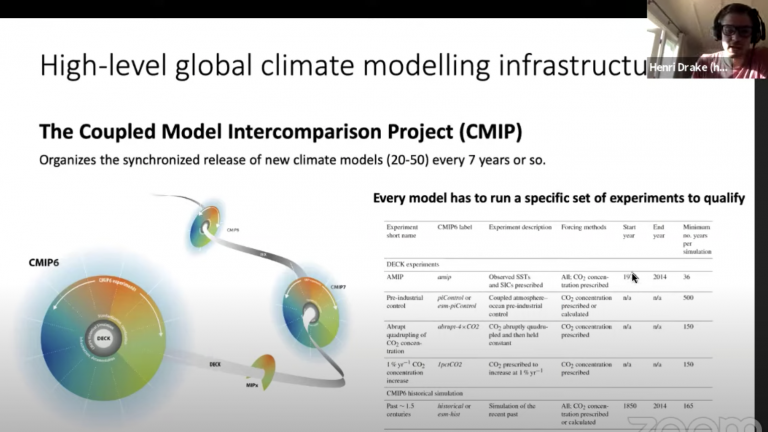
This introductory course on computational thinking uses the Julia programming language to approach real-world problems in varied areas, applying data analysis and computational and mathematical modeling. In this class you will learn computer science, software, algorithms, applications, and mathematics as an integrated whole. Topics include image analysis, particle dynamics and ray tracing, epidemic propagation, and climate modeling.

View the course here. It includes a complete set of with lecture videos, Julia notebooks, and homework assignments. Climate modeling is covered in class sessions 20-25.

Instructors: Prof. Alan Edelman, Prof. David P. Sanders, Grant Sanderson, Dr. James Schloss, and Henri Drake

by MIT OCW
Topics
Climate Modeling
Education

Related Posts

PodcastOctober 8, 2026

E11: Data centers and the race to power AI (part 2)

Ask MIT Climate Podcast
Ask MIT Climate
PodcastOctober 8, 2026

E10: Data centers and the race to power AI (part 1)

Ask MIT Climate Podcast
Ask MIT Climate
PostSeptember 18, 2026

MIT researchers are mapping extreme weather risks — and building tools to...

MIT News
The  “New World of Weather” project, one of MIT’s five Climate Grand Challenges announced in 2022, is “advancing the science, technologies, and practical strategies needed to help communities anticipate [extreme weather] and build greater resilience,” says MIT Vice President for Energy and Climate Evelyn Wang.
PostAugust 31, 2026

Playing against climate risk

MIT News
Left to right: Researchers Anamitra Saha and Sai Ravela of the MIT Department of Earth, Atmospheric and Planetary Sciences, and Jayanta Basu of the University of Calcutta design the board for a "snakes and ladders" game. The game is the first step in encouraging community members to use an app-based simulation that suggests solutions to their unique geographical and environmental challenges.

MIT Climate Knowledge in Your Inbox


MIT Groups Log In

Log In

Footer

  • About
  • Terms & Conditions
  • Privacy Policy
  • Accessibility
  • Contact
MIT Climate Project
MIT
  • Instagram
  • TikTok
  • YouTube
  • Simplecast
Communicator Award Winner