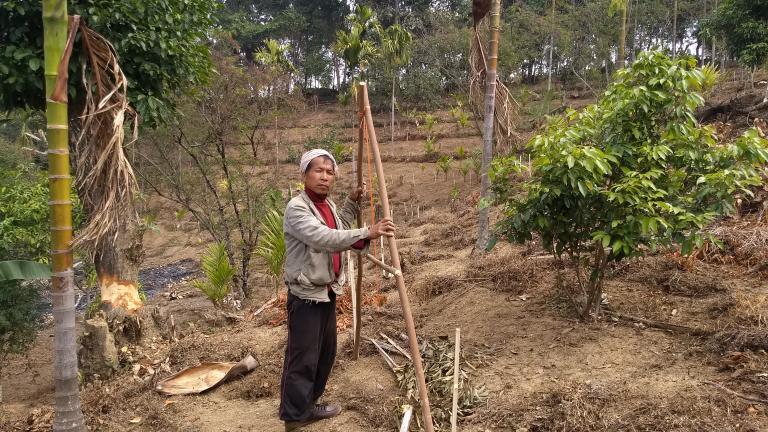
How can hill tribes in India transition to sustainable agriculture practices amidst climate crisis? Judges and popular choice winner of the Land Use: Agriculture, Forestry, Waste Management 2018 Climate CoLab contest, David Gandhi, has developed an intervention strategy.
To offer pragmatic and environmentally conscious solutions for farmers in North-East India, David Gandhi and his team have developed the SALT approach. While “slash and burn” or shifting cultivation techniques have been used for generations, they are no longer sustainable due to rising CO2 levels and infrastructure issues. His innovative approach that led to a win at Climate CoLab, SALT (Sloping Agriculture Land Technology), integrates into farmers’ techniques and lifestyles, and has the added benefit of cost efficiency.

After living in Aben, India for 18 months, Gandhi developed an in-depth understanding of how climate change is impacting frontline communities in northeast India. The slash and burn technique, or as it is known locally, “jhum”, comes at a significant cost to the environment. Impacts include air pollution, soil erosion, landslides, and damage to surrounding vegetation. While alternatives to jhum have been attempted by governmental and scientific organizations, they have lacked pragmatic or economic efficiency.
SALT utilizes vegetative barriers of nitrogen fixing plants (NFPs) to control crops exposure to water and improve soil fertility. These hedgerows of vegetative barriers are trimmed and maintained regularly, and the clippings are utilized as mulch. Crops are grown in the spaces between the hedgerows, and protected by the surrounding mulch. Animal agriculture also seamlessly integrates into the SALT technique. Animal dung is used as compost, and smaller livestock, such as goats, can graze within SALT-designed spaces.
Unlike jhum, SALT does not pollute the air, damage surrounding vegetation, or harm the soil. SALT also utilizes natural barriers and fertilizers, rather than contaminating the earth with chemicals. In addition to its environmental benefits, it also does not come at a high monetary cost for farmers; this allows them to profit more off their produce.

According to Gandhi, in applying SALT, the greatest action that needs to be taken is community mobilization and education. As jhum has been utilized for generations, there is resistance in transitioning into new agricultural practices. Gandhi cites four organizations as instrumental in implementing SALT: The Village Development Committees of Aben (VDC), the Peoples Endeavor for Social Change (PESCH), Mrida Group, and the Rongmei Naga Baptist Association. In looking at how agricultural and environmental issues are intersectional, collaboration with local government and social organizations was essential.
During the monsoon season of 2017, a successful pilot SALT project was launched in Manipur, Aben. The Village Development Committees of Aben noted that the turmeric grown in this project fetched higher prices on the market and had fewer negative environmental impacts, such as soil erosion. Gandhi and his team are excited to see SALT applied more broadly in the region, and how the momentum from the Judges and Popular Choice Award at Climate CoLab has shed light on these important issues. This model has great potential to be applied in many environments, and be a part of lasting agricultural and environmental change.