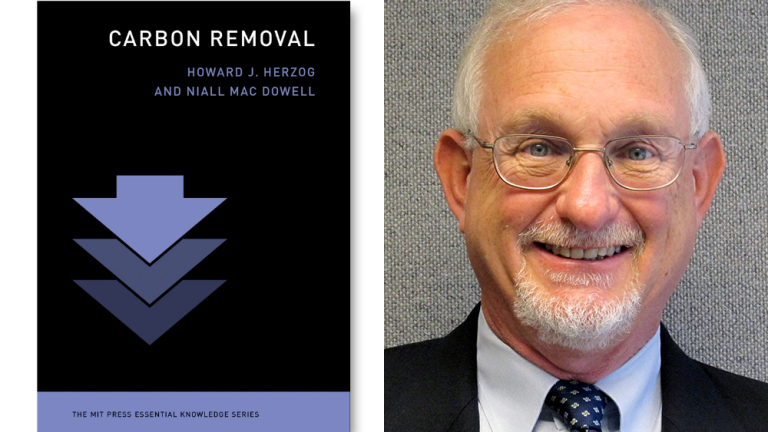
Two leading experts in the field of carbon capture and sequestration (CCS) — Howard J. Herzog, a senior research engineer in the MIT Energy Initiative, and Niall Mac Dowell, a professor in energy systems engineering at Imperial College London — explore methods for removing carbon dioxide already in the atmosphere in their new book, “Carbon Removal.” Published in October, the book is part of the Essential Knowledge series from the MIT Press, which consists of volumes “synthesizing specialized subject matter for nonspecialists” and includes Herzog’s 2018 book, “Carbon Capture.”
Burning fossil fuels, as well as other human activities, cause the release of carbon dioxide (CO2) into the atmosphere, where it acts like a blanket that warms the Earth, resulting in climate change. Much attention has focused on mitigation technologies that reduce emissions, but in their book, Herzog and Mac Dowell have turned their attention to “carbon dioxide removal” (CDR), an approach that removes carbon already present in the atmosphere.
In this new volume, the authors explain how CO2 naturally moves into and out of the atmosphere and present a brief history of carbon removal as a concept for dealing with climate change. They also describe the full range of “pathways” that have been proposed for removing CO2 from the atmosphere. Those pathways include engineered systems designed for “direct air capture” (DAC), as well as various “nature-based” approaches that call for planting trees or taking steps to enhance removal by biomass or the oceans. The book offers easily accessible explanations of the fundamental science and engineering behind each approach.
The authors compare the “quality” of the different pathways based on the following metrics:
Accounting. For public acceptance of any carbon-removal strategy, the authors note, the developers need to get the accounting right — and that’s not always easy. “If you’re going to spend money to get CO2 out of the atmosphere, you want to get paid for doing it,” notes Herzog. It can be tricky to measure how much you have removed, because there’s a lot of CO2 going in and out of the atmosphere all the time. Also, if your approach involves, say, burning fossil fuels, you must subtract the amount of CO2 that’s emitted from the total amount you claim to have removed. Then there’s the timing of the removal. With a DAC device, the removal happens right now, and the removed CO2 can be measured. “But if I plant a tree, it’s going to remove CO2 for decades. Is that equivalent to removing it right now?” Herzog queries. How to take that factor into account hasn’t yet been resolved.
Permanence. Different approaches keep the CO2 out of the atmosphere for different durations of time. How long is long enough? As the authors explain, this is one of the biggest issues, especially with nature-based solutions, where events such as wildfires or pestilence or land-use changes can release the stored CO2 back into the atmosphere. How do we deal with that?
Cost. Cost is another key factor. Using a DAC device to remove CO2 costs far more than planting trees, but it yields immediate removal of a measurable amount of CO2 that can then be locked away forever. How does one monetize that trade-off?
Additionality. “You’re doing this project, but would what you’re doing have been done anyway?” asks Herzog. “Is your effort additional to business as usual?” This question comes into play with many of the nature-based approaches involving trees, soils, and so on.
Permitting and governance. These issues are especially important — and complicated — with approaches that involve doing things in the ocean. In addition, Herzog points out that some CCS projects could also achieve carbon removal, but they would have a hard time getting permits to build the pipelines and other needed infrastructure.
The authors conclude that none of the CDR strategies now being proposed is a clear winner on all the metrics. However, they stress that carbon removal has the potential to play an important role in meeting our climate change goals — not by replacing our emissions-reduction efforts, but rather by supplementing them. However, as Herzog and Mac Dowell make clear in their book, many challenges must be addressed to move CDR from today’s speculation to deployment at scale, and the book supports the wider discussion about how to move forward. Indeed, the authors have fulfilled their stated goal: “to provide an objective analysis of the opportunities and challenges for CDR and to separate myth from reality.”